

『Gf Signet Paddle Wheel Flow Meter Troubleshooting: Cleaning Impellers and Fixing Low Pulse Faults』Related information(flow rotameter|digital flow meter|balo meter|hydraulic flow meter|volumetric meter|positive displacement meter|pitot tube flow meter|displacement meter|cfm meter|variable area flow meter|inline flow meter|differential pressure flow meter|calibrated flow meter|velocity meter|paddle wheel flow meter|oval gear flow meter|anemometer hvac|multiphase flow meter|doppler flow meter|thorpe tube flowmeter|heat flow meter)
GF Signet Paddle Wheel Flow Meter Troubleshooting: Cleaning Impellers and Fixing Low Pulse Faults
Quick Answer: A low pulse fault on a GF Signet paddle wheel meter usually means the impeller is coated, jammed, or not seated at the correct depth. Remove the sensor, clean the impeller with a soft brush and weak acid, then check the insertion depth and power supply. If the pulse output stays below 1 Hz under normal flow, replace the sensor or upgrade to a Silver Instruments electromagnetic flow meter.
Common Symptoms of a Low Pulse Fault
Engineers usually notice the fault in the PLC or display unit. The flow reading may jump from 40 m3/h to zero within minutes. In some cases the pulse frequency drops but does not stop. A cooling tower in Thailand had a GF Signet 2536 meter that read 2.5 m3/h while the actual flow was 38 m3/h. The problem was not the transmitter. The impeller had a layer of calcium scale and biofilm.
Low pulse output often appears on wastewater, cooling water, and seawater lift pump lines. The impeller sits in the media. Sludge, sand, iron oxide, and calcium carbonate collect on the rotor pin and magnets. When the rotor slows down, the Hall effect sensor generates fewer pulses per second. The 4-20 mA output may still read 4 mA because the loop is powered. That confuses many technicians.
Step by Step Impeller Cleaning Procedure
Most GF Signet paddle wheel sensors have a removable sensor body. On a DN50 or DN80 line, close the upstream and downstream isolation valves first. Depressurize the pipe to zero bar. Wait until the pipe temperature is below 40 °C. Then loosen the sensor nut slowly. Do not pull the sensor out with force if the pipe is still hot or under pressure.
Take the sensor to a clean bench. Remove the retaining ring or clip that holds the impeller. Pull the impeller off the shaft. Use a soft nylon brush to remove large debris. Soak the impeller in a weak acid solution. A 5 percent citric acid or 5 percent acetic acid mix works for calcium scale. Do not use strong hydrochloric acid on plastic impellers. It can make the PVDF or polypropylene body brittle. For biofilm and algae, use a 50 ppm sodium hypochlorite solution. Rinse with clean water after 15 minutes. Dry the impeller with compressed air at 1.5 bar maximum.
Inspect the shaft and bearings. If the shaft is worn more than 0.1 mm, the rotor will wobble. A worn shaft can produce random pulse spikes even after cleaning. On wastewater lines, we have seen small fibers wrap around the shaft. Cut the fibers with a utility knife. Do not pull them. Pulling can bend the shaft. Most engineers skip this part. They clean the impeller but forget to check the shaft and bearing clearance. Reassemble the sensor. Spin the impeller by hand. It should rotate freely for at least 3 seconds after a finger flick. If it stops immediately, check the alignment and the shaft.
Sensor Depth and Pipe Size Check
GF Signet paddle wheel flow meters need the impeller tip to sit at the pipe centerline or slightly below. The insertion depth is marked on the sensor stem. For a DN50 pipe, the depth is usually 23 mm to 25 mm from the pipe wall. For a DN100 pipe, the depth is around 50 mm. If the sensor is installed too shallow, the impeller only catches the slower boundary layer flow. The meter will under-read. If the sensor is inserted too deep, the rotor can scrub the opposite pipe wall and wear out.
Check the pipe inner diameter dimension. Do not trust the nominal pipe size alone. Schedule 40 and Schedule 80 pipes have different internal diameters. A DN50 Schedule 40 steel pipe has an inner diameter near 52.5 mm. A DN50 Schedule 80 pipe has an inner diameter near 48.5 mm. The insertion depth changes. Wrong depth is a common reason for low pulse output after a sensor replacement.
Power Supply and Pulse Output Wiring
A GF Signet paddle wheel sensor needs a DC supply. The typical range is 5 to 24 VDC, depending on the model. If the supply voltage drops below 4.8 VDC at the sensor terminals, the pulse amplitude will be weak. The PLC input may not count the pulses correctly. Measure the voltage with a multimeter while the pump is running. A long cable run of 100 m with 0.5 mm2 conductors can drop 1 to 2 V. Use a local power supply if the voltage at the sensor falls below the minimum.
Check the pulse wire polarity. Reverse polarity on the signal and common terminals can damage some older GF Signet sensor modules. Here is the thing. The pulse output is an open collector square wave. A pull-up resistor of 1 kΩ to 10 kΩ may be needed if the PLC input does not have internal pull-up. The frequency should be stable when flow is stable. A clean meter on a DN80 line at 2 m/s may output around 60 Hz to 120 Hz depending on the K-factor. If the frequency jumps from 80 Hz to 3 Hz and back, the impeller or the cable i
When to Replace the Paddle Wheel Sensor
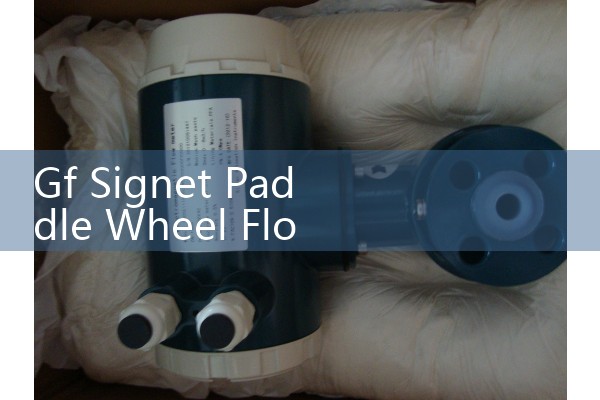
Cleaning fixes most low pulse faults on GF Signet paddle wheel meters. But some sensors are beyond repair. Replace the sensor if the rotor pin is bent, the magnets are cracked, the Hall effect chip is corroded, or the PVDF body has stress cracks. A cracked body can leak and cause water damage to the coil. On seawater services, stainless steel shafts can pit within 12 to 18 months. A pitted shaft increases friction. The rotor slows down and the pulse output drops.
If the GF Signet sensor has been in service for more than 5 years on a dirty line, the cost of repeated cleaning may exceed the cost of replacement. Last year a customer in Vietnam asked us to replace five GF Signet sensors on a paint process line. Titanium dioxide pigment kept fouling the paddle wheel rotors. The customer switched to Silver Instruments EMF series electromagnetic flow meters. The low pulse faults stopped. Silver Automation Instruments offers paddle wheel flow meter replacements for many GF Signet mounting configurations. We also stock electromagnetic flow meters that do not have moving parts. Electromagnetic flow meters work better on slurry, wastewater, and lines with grease or fibers. For clean water and cooling water, a replacement paddle wheel sensor is usually the fastest fix.
Recommended Silver Instruments Replacement Options
Silver Instruments supplies PWT series insertion paddle wheel flow sensors for pipe sizes from DN15 to DN600. The sensor body is PVDF with a ceramic shaft and PTFE bearings. The pulse output is an open collector square wave. The supply range is 5 to 24 VDC. The flow range is 0.3 to 6 m/s. The standard cable length is 10 m. The K-factor is printed on each sensor tag, for example 19.5 pulses per liter. This makes calibration on site simple. The PWT series works as a direct replacement for many GF Signet 2536 and 2540 installations. The insertion depth and hot-tap fitting are the same on most configurations.
For dirty water, cooling tower blowdown, or seawater, Silver Instruments recommends the EMF series electromagnetic flow meter. It has no impeller to clean. The liner is PTFE or hard rubber. The electrodes are 316L stainless steel, Hastelloy C, or titanium. The size range is DN10 to DN1000. The output is 4-20 mA HART, pulse, and RS485 Modbus. Accuracy is 0.5 percent of reading. The EMF series costs more than a paddle wheel sensor but eliminates recurring low pulse faults. The EMF series is also available with ATEX Zone 1 approval for hazardous areas.
FAQ: GF Signet Paddle Wheel Low Pulse Faults
Why does my GF Signet paddle wheel meter read zero flow but the pump is running?
The impeller is most likely jammed or coated. Remove the sensor and clean the impeller. Then check the insertion depth and the cable. If the pulse output is still zero, measure the supply voltage at the sensor. If the supply is correct, the Hall effect sensor may have failed.
Can I clean a GF Signet paddle wheel impeller without removing the sensor from the pipe?
No. You need to isolate and depressurize the line first. Then remove the sensor. Cleaning in place with acid injection is risky and often damages the plastic body or the downstream equipment. Always remove the sensor and clean it on a bench.
What is the normal pulse frequency for a GF Signet paddle wheel meter?
The pulse frequency depends on the K-factor and the flow velocity. A typical K-factor is 19 to 20 pulses per liter. At 100 l/min on a DN50 line, the frequency is near 33 Hz. At 5 l/min it is near 1.6 Hz. If the frequency is much lower than expected, check the impeller and the sensor depth.
How often should I clean a paddle wheel impeller on a cooling water line?
In clean cooling water, clean every 6 to 12 months during planned shutdowns. In open cooling towers with high hardness, clean every 2 to 3 months. In wastewater or seawater, install a strainer or switch to an electromagnetic flow meter. Frequent cleaning shortens the shaft life.
Can Silver Instruments supply a replacement sensor for a GF Signet 2536 paddle wheel meter?
Yes. Send us your pipe size (DN), insertion depth, process fluid, temperature, and the existing GF Signet model number. We can supply a PWT series paddle wheel sensor or an EMF series electromagnetic flow meter. Contact Silver Automation Instruments by Tel: +86-25-68650347, WhatsApp: +86-25-52155837, or WeChat: +86 15365082610.
Need a replacement flow meter fast?
Send us your pressure in bar, temperature in °C, pipe size in DN, flow range in m3/h, and the fluid type. We will recommend a Silver Instruments paddle wheel or electromagnetic flow meter within 24 hours. Our main website is flow-meter.com.au. We ship to Southeast Asia, Oceania, Latin America, Africa, and the Middle East.
 Hot Blog
 Related AD